sábado, 9 de abril de 2016

SPACES & EXCHANGES - Written work on two individual documents Exchanges in Real Spaces & Virtual Spaces


In order to illustrate the notion of "Spaces and Exchanges" through both virtual and real spaces, I have picked two documents: a cartoon illustrating virtual spaces and and a video illustrating real spaces.
Social Media In Real Life, published by cartoonist Sarah See Andersen on her Tumblr Blog which can be found here.

I found this cartoon interesting in order to illustrate this notion, since it represents social media (a virtual space) actually transformed into a real space: a big stage in which the main character is standing. She allegedly shows how social media would be like if it went beyond a mere screen and became everyone's way of communicating in real life, and we realize it's a nonsense. By making the little girl shout in front of a huge crowd something as irrelevant as the fact she just ate a burger, the author makes us aware of how people posting on social media are attention-seekers who are looking forward to make 'public' every tiny detail of their lives.  Nevertheless, the crowd seems somewhat interested about the information given (they randomly shout "like!" and "me too!"). What the author means is, perhaps, that we are focusing too much on virtual spaces although they rarely provide useful information.


The Suburbs official video directed by Spike Jonze, song by canadian-american band Arcade Fire introducing their homonym album in 2010.


This song's lyrics are the following:


In the suburbs I
I learned to drive
And you told me we'd never survive
Grab your mother's keys we're leavin'

You always seemed so sure
That one day we'd fight in
In a suburban world
your part of town gets minor
So you're standin' on the opposite shore
But by the time the first bombs fell
We were already bored
We were already, already bored

Sometimes I can't believe it
I'm movin' past the feeling
Sometimes I can't believe it
I'm movin' past the feeling again

Kids wanna be so hard
But in my dreams we're still screamin' and runnin' through the yard
And all of the walls that they built in the seventies finally fall
And all of the houses they build in the seventies finally fall
Meant nothin' at all
It meant nothin

Sometimes I can't believe it
I'm movin' past the feeling
Sometimes I can't believe it
I'm movin' past the feeling and into the night

So can you understand?
Why I want a daughter while I'm still young
I wanna hold her hand
And show her some beauty
Before this damage is done

But if it's too much to ask, it's too much to ask
Then send me a son

Under the overpass
In the parking lot we're still waiting
It's already passed
So move your feet from hot pavement and into the grass
Cause it's already passed
It's already, already passed!

Sometimes I can't believe it
I'm movin' past the feeling
Sometimes I can't believe it
I'm movin' past the feeling again

I'm movin' past the feeling

In my dreams we're still screamin'
We're still screamin'
We're still screaming'


I chose this song not only because I find it enriching and beautifully written, but also since it offers a completely different overview of something as traditional (and somewhat boring) as the suburbs that can be found in the peripheral area of every big American city, inhabited by middle-class families. This song begins with a honkey tonk piano, and the first stanza of the lyrics is quite innocent: it illustrates the life of an average suburban family. The lyrics are narrated by a young man evoking his childhood in the suburbs, remembering how sweet and innocent his life used to be before his dreams were forced through the meat grinder of real life. When he was a child, everything from outside the suburbs, such as war, seemed distant and irrelevant ("but by the time the first bombs fell we were already bored"). Now he looks back feeling nostalgic. He realizes everything he believed in back then was meaningless and unreal, but still he would have that rather than the real world he has been forced to discover during his adulthood, in which every trace of beauty is being brutally destroyed. This song introduces a real space through one of his inhabitant's viewpoint, which makes us see the suburbs  in a more complex, yet intimate, way. 


domingo, 13 de marzo de 2016

POST 11: SPACES & EXCHANGES: ¿Qué? A cartoon by Nate Beeler (2007)

As we have already reacted together in class to a few Nate Beeler political cartoons concerning USA primaries and focusing on the character of Donald Trump, I thought it could perhaps be more interesting to deal with some cartoons that have an aim other than to denounce Trump and his rising power and influence in the country. There are many controversies right now concerning not only the USA but also a great part of the planet and these cartoons aims to illustrate some of them. 


The Apple company has a worldwide reputation for producing high quality phones, tablets and computers. This firm has, however, an agreement with the FBI which allows their agents to virtually break into a very specific person's device in case they believe this person has done something that goes against the law. To do this, they need the consent of the whole firm; but a few weeks a go the FBI asked Apple the right to break into anyone's electronic devices without having to ask for permission to the company; which Apple denied forthright. This cartoon illustrates the strength of the company (symbolized through the image of an iPhone) when facing the aggressive pressure of the FBI, who wants to symbolically break into that phone. There is a message on the screen, that says "Right to Privacy" along with the icon of the company: a bitten Apple. Still, the screen is starting to get damaged by the huge machine that represents the FBI: the cartoonist thinks that, eventually, the firm might succumb to FBI's pressure. 


There is a massive problem in the United States that concerns all citizens (as long as they want to have an education): College Fees. In American culture, the college or university a person will attend is decisive for his or her future professional career, as a college is a symbol of social empowerment. Someone who will study at an Ivy League University won't have any problem when it comes to finding a good job later on in his life; whilst someone attending a random college will struggle a lot more. Colleges have become a symbol of the social elite; and a family often needs to save money for many years so their child can attend a good college. This cartoon shows a morbid obese man wearing a hospital gown in which we can read "Public Colleges" (hence the man stands for high colleges fees). He is supposed to weigh himself in a balance that says "State Audit"(In America, the State Audit conducts financial and compliance and performance audits, investigations, and special studies to provide the General Assembly, the Governor, and the citizens with objective information about the state’s financial condition and the performance of the state’s many agencies and programs). Public Colleges are supposed to show their fees are lower, or at least that's what the government wants to do in order to satisfy people, but somehow Public Colleges, that are supposed to obey the government since they are public institutions, always  find a way to increase educational fees.  


This cartoon was published by Nate Beeler on 03/09/2007


I) Here, we can see a stereotypical american show presenter or a reporter dressed in an elegant black suit and followed by a tv camera man. The presenter is smiling and holding a mic, and by his words we can see he's getting ready to interview the "300 millionth American". Still, by his side we see a quite poor man, barefoot and wearing stained clothes, who is holding on to his few belongings. He still has a piece of electrocuted fence at his feet, which shows he just crossed the border that separates Mexico and the United States. He asks "Qué?" to the presenter, as he doesn't speak english and therefore cannot understand what he's being told. There is a very strong contrast between these two groups of characters. 

II) Every year, thousands of hispanic immigrants cross the border that separates Mexico and the USA as they crave the land of opportunity that country has become to their eyes; they see it as a possibility to escape the extreme poverty they are surrounded by in their home countries. The immigrants do not come necessarily from Mexico; they come from anywhere in Central and South America and sometimes they have to cross many countries in order to reach Mexico and reach the USA from there. Nevertheless, those immigrants once they arrive to the United States (if they do) must face the fact that they have become an ethnic minority and live in a country that is not theirs, surrounded by a culture they don't truly understand. They have become "foreign Americans"which translates in social exclusion and many difficulties when it comes to, for example, finding a job. This cartoon shows that, nowadays, Americans do not only come from America and that the country is forced to involve in their culture and society people who do not feel, in any way, identified with it. 

III) This cartoon illustrates the notion "Spaces and Exchanges" by showing the crash between two cultures that are being confronted nowadays dure to the massive wave of hispanic immigration in the United States. This confrontation takes place within a limited space: the borders of the country. In this picture, that opposition is visual: the compere is dressed in a very elegant way that contrasts violently with the poverty of the clothes the latino immigrant wears. Also, they do not even speak the same language or understand each other: there is going to be an exchange, but it's going to be really limited since the contrast between the two groups each character represents here is huge. 


domingo, 31 de enero de 2016

POST 10 : TATTOOS & GANGS


-Tattoos nowadays have become a way of obtaining recognition, both from one's self as well as from others. People are able to spread their belonging to a social or cultural group just through a certain design on their skin and by doing so they show they are someone in a society where the individual (with its personality and ideas) gets lost, since anyone is able to share their information on social networks. Globalization is rising in our current society and that implies a standardization of lifestyles, which makes people want to prove they are different from the rest, and a separate from the majority often means joining a minority, that's why people decide to dye their hair blue or get a tattoo in order to be grunge or hipsters. Being special is not enough anymore, you have to claim your differences through your body.
The fact that there are many celebrities getting their skin inked also might increase people's urge to get a tattoo as well, since it's a way of feeling related to them.
 
Alex Turner from the (great) british band Arctic Monkeys showing his tattoo of Sheffield's flower


-Young people join gangs for more less the same reasons some youngsters get tattoos and piercings: they want to belong to a group. Still, those who join gangs have an almost painful need to feel they are not alone, whilst the great majority of teens who decide to get a tattoo come from functional families with a social background considered "normal". They might feel the need to prove how free and independent they are, but that's all. Young people who join street gangs are completely torn apart.
They often come from families that were not able to provide them affection and support, which any child needs in order to grow up both physically and mentally healthy, so they look for this kind of support in street gangs. They are like a family to them.
In the years 1990', street gangs have become more and more powerful through the admiration some symbolical celebrities arise in young people. A good example is  the worldwide known rapper Tupac Shakur,  who got his reputation from the fact of representing the ghetto lifestyle and became a myth after being shot to death when he was only 25. Street gangs are attractive to young people.


THE NOTION OF POWER

Both street gangs and tattoos make people feel the illusion of being empowered and having the control of their own lives, as they are allegedly against the whole society. They feel like they choose their own power over the power society might have over them, so they can reach a state of freedom and independence that most people won't ever know for as long as they live. That's what pushes them towards the idea of joining a social minority (such as street gangs) or a cultural minority (such as goths or hipsters). Still, nowadays both street gangs and cultural minorities people are  desperately trying to relate to are trivialized. They don't shock anymore a society that is getting used to it. Tattoos and street gangs provide people with a false sensation of power that is slowly fading away, since nobody reacts to it anymore.


martes, 19 de enero de 2016

The Draw of 'Dead Town' - A Newsweek article (February 16, 2009)

Newsweek Article


I) Gabriel Hinojos used to be member of Florencia 13, on of the most important gangs in Los Angeles. He has belonged there for many years, but still now he has decided to leave behind his lifestyle of crime and misdemeanor by getting out of his street gang, which implies getting all his tatoos removed (as shown in the picture). Now, Gabriel has become "a kind of poster child for leaving behind the gang life".

II) "Ya 'Stuvo" is the tattoo removal center in which Gabriel Hinojos is getting his street gang tattoos eraised from his skin through what he describes as a very painful process. The name, "spanish slang for "that's enough, I'm done with that"" is symbolical, since people usually get their tattos removed when they are ready to leave behind whatever the tattoo means to them, when they feel they are done whith them  (as tattoos itselves often represent something else, something deeper that what is shown and that only few people can fully understand). 

III) In this article, "Black teardrops" refears to the black, tear-shaped tattoo street gangsters get everytime their either kill someone or everytime they are imprisonned. Gabriel Hinojos seems to have several of them, as they have to be removed from the skin under his eye, which seems extremely painful to him. Black teardrops are something street gangsters feel extremely proud of, since they are public demonstrations of how dangerous they can be, of the success they have achieved as gangsters. They get this tattoo on their face so it's easier for them to show-off. 


IV) The fact that Gabriel Hinojos has to visit Ya 'Stuvo more than 45 times in order to get all his tattoos removed (since we assume there are still many visits left before the process is finally done) implies that his body must be, indeed, completely inked since it's taking so long for him to get them eraised. That means he must have been very found of his gang and probably comitted huge crimes several times. Also, it means he is perseverant in his purpose of leaving behind his life as a gangbanger, since he is strong enough to attend more than 45 sessions of tattoo removing. 


V) Getting out of a street gang in L.A isn't easy at all. In fact, the article describes it through a comparison to the process of getting your tattoo removed: "slow, painful, scarring" (line 17).

VI) It is not always possible, as some street gangs doesn't allow their members to leave at all. The text explains, "In street lore, a gang banger can never a really brutal gang like Mara Salvatrucha13" (line 17).

VII) Few street gangs allow their members to leave, and even those that do make people go through a lot, which makes it extremely hard for anyone to ever leave a street gang. A gang banger can only exit his street gang if he has "done the work", which implies comitting some kind of crime and misdemeanor (the gravity of the crimes they force you to commit depends on how aggressive the gang is, I suppose). Most of the time, people have also to serve time in prison. 

VIII) "Escaping the pull of gang life is extremely difficult" means that, once you have belonged to a street gang, your mindset and your lifestyle are so used to it that you can barely imagine your life without everything that implies belonging to a street gang: human decay, social misbehavior and a criminal way of thinking are now so rooted in your person, they almost define your whole identity and now Gabriel can't even imagine life out of his street gang, which makes it really hard for him to build his life up again. He feels the constant need to drive back to his neighbourhood. 


IX) Now Gabriel has presomptly left behind his life as a member of a street gang, government wants him to become a "poster child", an example of good behavior so it can inspire other yougsters to follow the right social path, and the fact that he is invited to sip white wine at the White House with former first lady Laura Bush (which is supposed to be a great honour, a huge condecoration) is meant to show gangsters what awaits them once they leave their life of misdemeanor behind. The last sentence, though , proves that all the efforts government made to show Gabriel as a good example miserabily failed because few months later he had completely forgotten his will to move on and got imprissoned again.

X) This photograph shows Gabriel Hinojos getting his tattoos removed from his skin by a person whose face is not shown. He is wearing sunglasses, so we cannot really see his whole face (which keeps some kind of mistery that shows he belongs to a hidden, a dark part of our society) but his mouth is twisted and we can see he's going though a painful moment. Anthough a part of his skin is actually clean, inkless, we can see how most of his body is still completely covered in tattoos so we can imagine how long the process is going to be, and how much suffering Gabriel is going to have to go though before it's done, and that's how it illustrates this article. This pic is a metaphor of the pain leaving a street gang implies.


sábado, 28 de noviembre de 2015

'Pop Art Myths' and the 'MYTHS & HEROES' Notion

 We are going to deal with the notion of Myths and Heroes related to the Pop Art movement that took place in the late 50'/early 60'. A myth is a popular belief or story that has become associated with a person, institution or ocurrence, especially one considered to illustrate a cultural ideal; while a hero is an historical or national character with political, social or cultural influence.


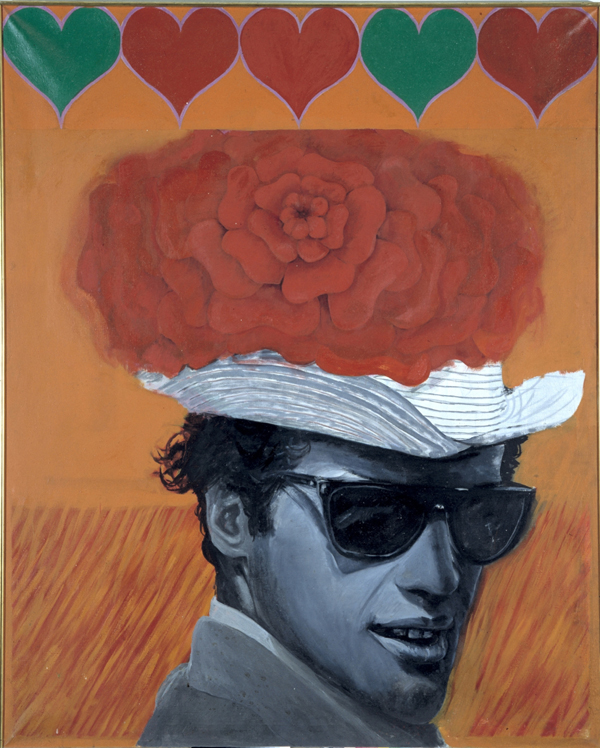
The Pop Art painting I have choose is entitled With love to Jean-Paul Belmondo and was made by Pauline Boty in 1962. In this Pop Art Portrait, we can see the succesful french actor Jean-Paul Belmondo painted in shades of grey, wearing sunglasses and a white stripped hat with a giant red flower on the top, and on top of it we can see five hearts (two green hearts and three red hearts). The whole is on an orange background with thin red stains at the bottom.
There are many ways in which this painting can be related to the notion of myths and heroes. The first one that came to my mind was Pauline Boty, the artist. 
                                     

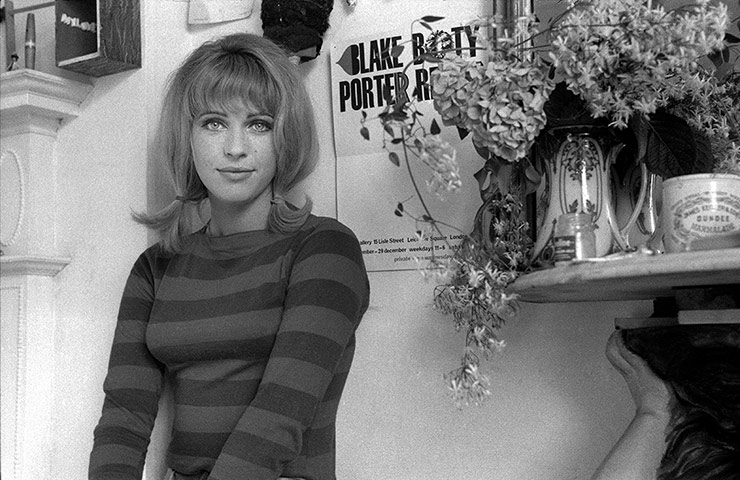
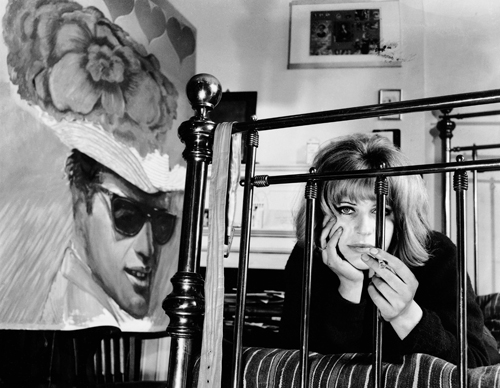
Pauline Boty (1938-1966) was the only female artist in the British Pop Art movement. Through her artistic productions (which included paintings and collages) she claimed the assertion of female sexuality in a society she described as a "Man's world", and in which she felt trapped in as an artist woman. Her rebellious art, combined with her free-spirited lifestyle, has made Pauline Boty a herald of 1970's feminism, following the steps of an ideology that had already been previously settled by other artists such as writers Sylvia Plath, Simone de Beauvoir and Virginia Woolf. 
We may consider her as a hero to some extent, since she took an active part in an artistic movement in which the main contributors were men (Andy Warhol, Richard Hamilton, Jasper Johns…) and was not intimidated by that fact whatsoever. She also became a a myth because of her early death caused by a cancer during her pregnancy: Pauline refused to take any medication that might have harmed the foetus and therefore died soon after giving birth to her daughter. She was only 28 years old, and thus we might consider her artistic productions as unachieved. We will never know what she might have painted all along her life if she hasn't died, and that's what makes her a myth.    

We can also relate this painting to the notion by focusing on the character painted: Jean-Paul Belmondo, who is worldwide considered as a myth of cinema culture. Belmondo is a symbol of the Nouvelle Vague movement that took place in France in the 1960's. He built himself that reputation throughout the reiterated collaboration with the filmmaker Jean-Luc Godard: he was the main character of many of his films. Breathless ("À Bout de Souffle") is the one that cemented his mondial reputation not only as a very talented actor, but also as a sex symbol.

Pop Art is essential to our modern mythology, and by that I do not mean to attribute to this movement artistic values that it clearly doesn't has. Manhood needed to go though Pop Art in order to rearrange its mindset and get a new perspective on art and the many forms it might take. Art is surrounding us at every single moment of our everyday life and that's what Pop Art tries to transmit to people. What Pop Artists seem to want to say is that, when you have a proper worldview of your background, you become able to turn anything into an artistic production. Still, when the relevance of an artistic movement leans on its ability to break up with classic art, artists don't need to be very talented. I do not consider Pop Artists particularly talented when it comes to artistic procedures, but still they all showed a  very specific ability to get a good perspective of the world and spread it through their artworks. Without Pop Art, we would probably not be able to thing of anything that doesn't respond to classic artistic criteria as "art". Pop Art has enlightened our culture, and hence yes, it is relevant to our modern mythology. 


domingo, 22 de noviembre de 2015

Pop Art Myths

Collage Advertising Comics

This exposition opens with several Pop Art precursors' collages. This form of art illustrates Pop Art movement (although it had also been previously present on Cubism and Dadaism) since collage becomes a tool for artists to show the aim for their artistic productions to become symbolical and break up with traditional art forms. Richard Hamilton and Andy Warhol's work are a good example of this tendency. British artists were important when introducing comics into the sphere of art, although American artists (such as Roy Lichtenstein  and Andy Warhol) were the ones who first turned comic strips into large format paintings.

 M-Maybe by Roy Lichtenstein, 1965, 152,4 cm x 152,4 cm, Ludwig Museum, Cologne, Germany 


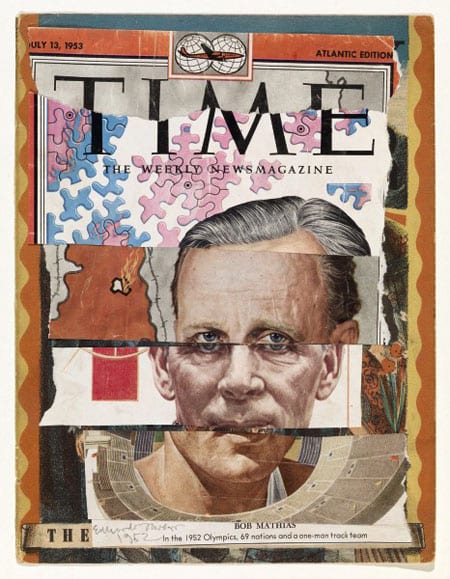
One Man Track Team, Eduardo Paolozzi,1953, collage, 10-3/4x 8-1/8 in. (27.3 x 20.8 cm). Tate Museum, London 


Emblems


By the mid-20th century, the development of consumer society triggered an important growth of the mass media, which started invading each one of the aspects of our daily life. The slogans, logos, etc were source of inspiration for Pop artists, who tried to acknowledge property of some of those symbols by turning them into art (for instance Jasper Johns, Peter Blake, Robert Indiana or Andy Warhol, to name a few).

Target with Four Faces, Jasper Johns, 1958, MoMa, New York

Epiphany, Richard Hamilton, 1964, Gagosian Gallery, New York 


Myths

Hollywood was going through its golden era and hence had become a star-making factory. The actors and actresses who succeeded in cinema became immediately symbols and myths with worldwide repercussion. Many Pop artists decided to focus some of their artworks in these popular figures. British Pop artists represented American Idols in their paintings but also added specific elements of their own popular culture (e.g. Blake's Beatles and Hamilton's Rolling Stones).


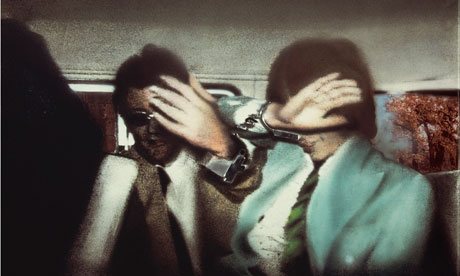
     Swingeing London 67, Richard Hamilton, 1969, MoMA, New York


With Love to Jean Paul Belmondo, Pauline Boty,1962, oil on canvas, 48 x 59 7/8 in. Collection of Nadia Fakhoury, Paris


Portraits

The development of Pop Art had a huge repercussion in the artistic genre of portraiture. Portraits went from being  merely an imitation to a genuine predecessor of reality. The traditional Pop artists didn't want to stick to realistic forms anymore; instead, they wanted to go further (which allowed them to open the door to postmodernism). Andy Warhol illustrates this idea, since in his portraits the model of the painting fades away to become a virtual image, and in the artworks he made after his attempted assassination, there is also a neat meditation on death. Allen Jones and David Hockney also worked on their own interpretation of the idea of what portraits should look like.
Darcey Bussel, David Hockney, 1994, National Portrait Gallery, London


 One of the eight paintings of Mao Tse Tung made by Andy Warhol in 1972


Landscapes Interiors Still Lifes


The rise of consumer society drags along new symbols: everyday objects are seen as representative. This leads to a reinterpretation of traditional paintings (landscapes, interiors and still lifes) by Pop Artists. They adapt these classical forms of painting and make them fit in current society through, to give an example, turning still lifes into a public, commercial space in contrast with the privacy they used to represent before. Each one of the artists showed a different view on the subject, such as Lichtenstein and Ed Ruscha, which made very different versions of landscapes. Paul Caulfield and Valerio Adami focused on interiors while Sigmar Polke, Allen Jones and Claes Oldenburg among others focused on Pop Still Lifes.

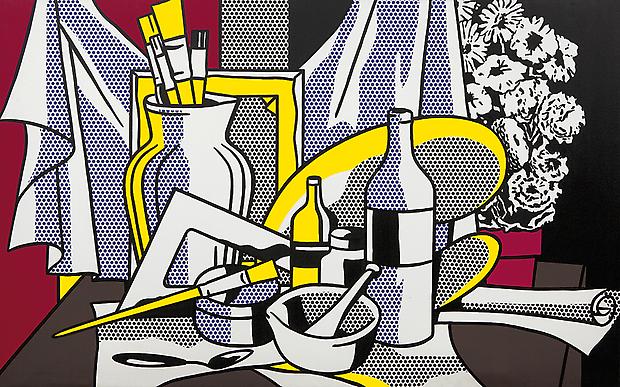
Still Life With Palette, Roy Lichtenstein, 1972, Acquavella Galleries Art, New York


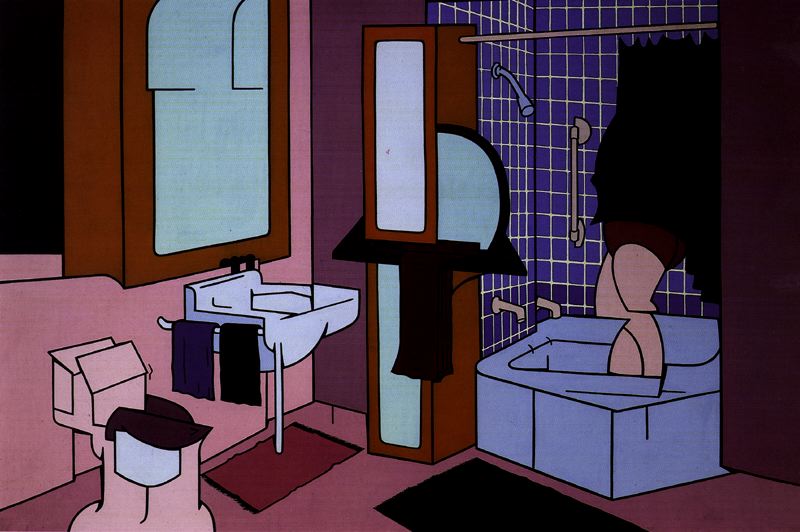
Hotel Chelsea Bathroom, Valerio Adami, 1968, , Belgium


Urban Eroticism 

The shift of social behavior that took place in the middle 1920' led to an until then unknown sexual freedom that was spread in every sphere of the society. As a result, erotic metaphors began to overwhelm mass media, displaying seductive women and attractive men. This carried weigh in Pop Art. Many Pop Artists started to represent voluptuous women in their artworks, such as Roy Lichtenstein, Richard Lindner and Allen Jones while others, like Tom Wesselmann through his odalisques, offer a personal interpretation of female nudes.
                                                   Cut-a-Way, Allen Jones, 1976


3 Girls, Sigmar Polke 


History Painting


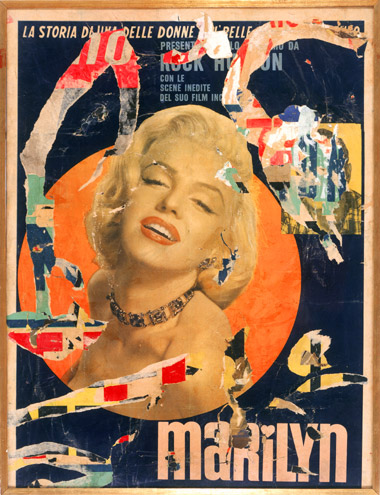
Pop Art iconography was largely inspired by historical and contemporary events. This leans both on the traditional historical painting, as well as in the diffusion of images caused by the mass media, giving Pop Artists the opportunity to rethink and reinterpret history in new artistic media. Rauschenberg, Warhol, Rotella and Richter among some others focus some of their artwork in relevant historical figures such as John Fitzgerald Kennedy and his widow Jackie, Mao Zedong, Richard Nixon, etc…In Spain, meanwhile, Pop Artists (Equipo Realidad, Juan Genovés, Eduardo Arroyo to name a few) aims to make a political denounce of the historical amnesia that afflicted the country, through Pop Art.


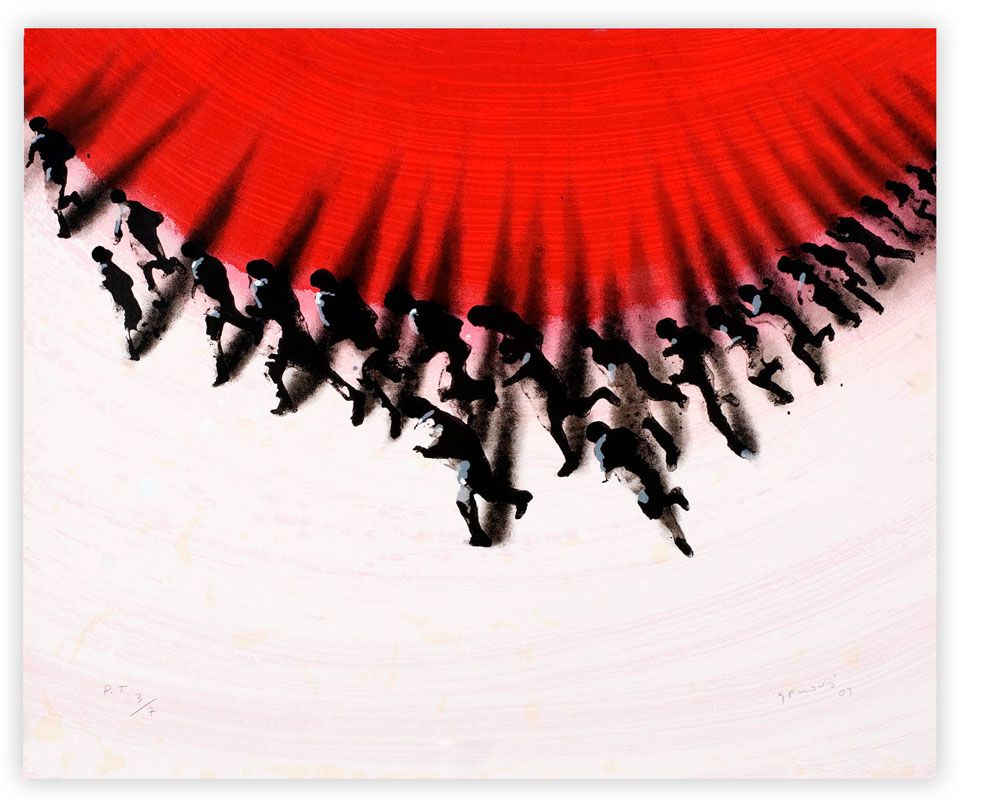
Shining, Juan Genovés

Marylin, Mimmo Rotella, 1963


Art about Art


The use of images about images in Pop Art leads to a questioning of art's evolution since the Old Masters is called "Art about Art". Each artist deals with a different artistic movement: Hockney and Warhol deal with Renaissance Art in very different ways. Other artists use "Art about Art" with a political aim, sometimes also by means of irony, or to criticize the way society venerated some avant-garde artists, such as Duchamp (known worldwide due to his successful "Fountain"); it is the case of Equipo Crónica, Luis Gordillo and Eduardo Arroyo respectively.     


El Intruso (The Intruder), Equipo Crónica, 1969